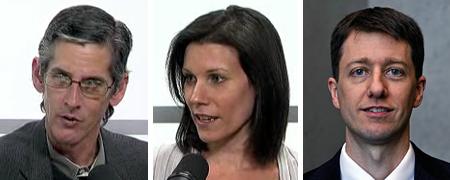
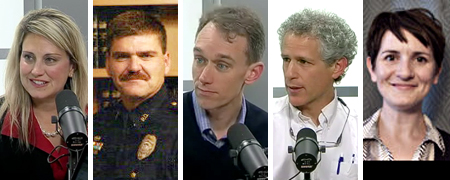
_A growing body of research is looking into the connections between spirituality and the functioning of the human brain. Our panelists take us on a journey into the deep recesses of the religious mind in hopes of answering some key questions: Is there a part of the brain that’s responsible for making people religious? Or is it the other way around, with spirituality affecting the way the brain operates? _Panelists: John Baker, executive director of the Community Foundation of Central Missouri and former pastor at First Baptist Church in Columbia Daniel Cohen, teaching assistant professor in the MU Department of Religious Studies Brick Johnstone, professor of health psychology in the MU School of Health Professions Andrew Newberg, neuroscientist and author of the book "Principles of Neurotheology" (joining the program by phone)
_With the holidays at hand, many of us will take time to appreciate and reflect on what we have. But what does it mean to be truly grateful in the modern world? How can parents instill a sense of gratitude in their children? And how do expressions of gratitude affect each of us as an individual and as a community? Panelists: John Battaglia, pastor of the Christian Chapel Church Robert Johnson, professor of philosophy at the University of Missouri Sharon Dunski Vermont, pediatrician and author of "The Gratitude Experiment" _
For many adults, navigating the murky waters of child-rearing can be among the most challenging parts of life. How do you balance freedom with discipline? How much responsibility is too much? And, importantly, how do you know when you're on the right track and doing a good job of it? In this discussion, which coincides with Columbia's " Week of the Parenting Journey," our panel of experts take your questions and discuss a six-part approach to effective parenting.
In the early 1950s, cancerous cells were taken from a tumor that killed a young black woman and became the first human cells to be successfully kept alive and replicated outside the human body. That cell line, known as HeLa, went on to become one of the most important ingredients in medical research, leading to several important breakthroughs -- and generating large profits for biomedical companies. But the woman and her descendants had no idea any of this was happening. The details of this true story are chronicled in this year's One Read book, "The Immortal Life of Henrietta Lacks." Our discussion focuses on the medical issues raised in the story, in particular how race, medicine, civil rights history and bioethics all come together in the book and in our world today. For more information about this year's One Read events, click here. Panelists: Doyne McKenzie, collections manager, Daniel Boone Regional Library Traci Wilson-Kleekamp, director of diversity and outreach initiatives, MU School of Medicine
On Aug. 26, Kraig Kahler, a former Columbia Water and Light director, was found guilty of killing his wife, his two teen-aged daughters and his wife’s grandmother, whose home they were visiting. The case raises the troubling question: How can a family in our community be destroyed in this kind of tragedy? In this discussion, we talk about how these kinds of shocking domestic violence events come to pass and, more importantly, how they might be prevented. IF YOU ARE IN AN ABUSIVE SITUATION AND NEED HELP, you can call the National Domestic Violence Hotline: 1−800−799−SAFE (7233) or TTY 1−800−787−3224 Panelists:Barbara Hodges, executive director, True North Zachary Wilson, development director, Missouri Coalition Against Domestic and Sexual Violence More information in the chat below Details about some of the work being done to help deter abusers was provided in the online chat room during today's discussion. Susan Schopflin, quality improvement director at Family Counseling Center of Missouri, described the work of M.E.N.D. (Men Exploring Non-violent Directions), a 27 week batterer intervention program. Click below to replay the chat and read what she had to say.
Hundreds of people in mid-Missouri have no place to call home, and the people who work with the homeless population say those in need are not always who you think. We take a look at how bad the need is, what assistance is already available and what else might be done to help the homeless in mid-Missouri. Hosted by KBIA Assistant News Director Ryan Famuliner.
Panelists: Cyndy Chapman, Regional Development Director, Columbia and Jefferson City Salvation Army Dianna Moore, director of economic development, Central Missouri Community Action Rebecca Roesslet, Social Services Supervisor, Columbia/Boone County Office of Community Services
Ongoing problems at Japan’s Fukushima Daiichi nuclear power plant have raised questions about nuclear power safety in the United States. What safety precautions are in place at the nuclear power plant in Callaway County? How might the situation in Japan affect plans for a second nuclear reactor there? And what is the latest in the science of nuclear power in general? Panelists: Scott Bond, manager of nuclear development, Callaway Power Plant Sudarshan Loyalka, Curators’ Professor of Nuclear Engineering, University of Missouri
How much of what we do is by choice, what philosophers and theologians call “free will”? And how much can be attributed to the unconscious workings of our brains? Can brain scans, such as functional MRIs, show what is happening in the brain? Can they predict violent criminal behavior - and if so, should they be admissible in legal proceedings? In advance of a symposium on the topic next weekend at MU, we invited a few experts to help explain how advanced study of the brain intersects with our humanity. Panelists: Phil Robbins, University of Missouri associate professor of philosophy and co-chair of the Life Sciences and Society Symposium planning committee Ines Segert, University of Missouri professor of psychology Jim Fallon, professor of anatomy and neurobiology, University of California-Irvine (joining by phone)
As the national political struggle continues over who should be allowed to marry, the number of couples saying “I Do” has been on the decline for the past 20 years. In celebration of Valentine’s Day our panelists address the question: How healthy is the state of marriage in our modern world? And, if it's really important to us as a society to support the institution of marriage, then what could be done to strengthen the individual unions across the land? Panelists: Tyler Jamison, doctoral student, MU Department of Human Development and Family Studies Susan Murray, psychologist and clinical director of MorningStar Counseling Center Steve Swope, pastor, Columbia United Church of Christ
A movement is afoot -- and Columbia is part of it -- to address what many call a serious problem: meeting the emotional needs of children. Today's conversation looks at how Columbia administrators, business leaders, community leaders and families are working together to address the emotional needs of the children in our community. It also gives some practical ideas about how parents can be more effective with their parenting. Link to information/schedule of related events in Columbia this week (PDF file)  Panelists:Jack C. Jensen, executive director, First Chance For Children Gerald Newmark, author of "How to Raise Emotionally Healthy Children" and founder of The Children’s Project Peter Stiepleman, assistant superintendent for elementary education, Columbia Public Schools
|